
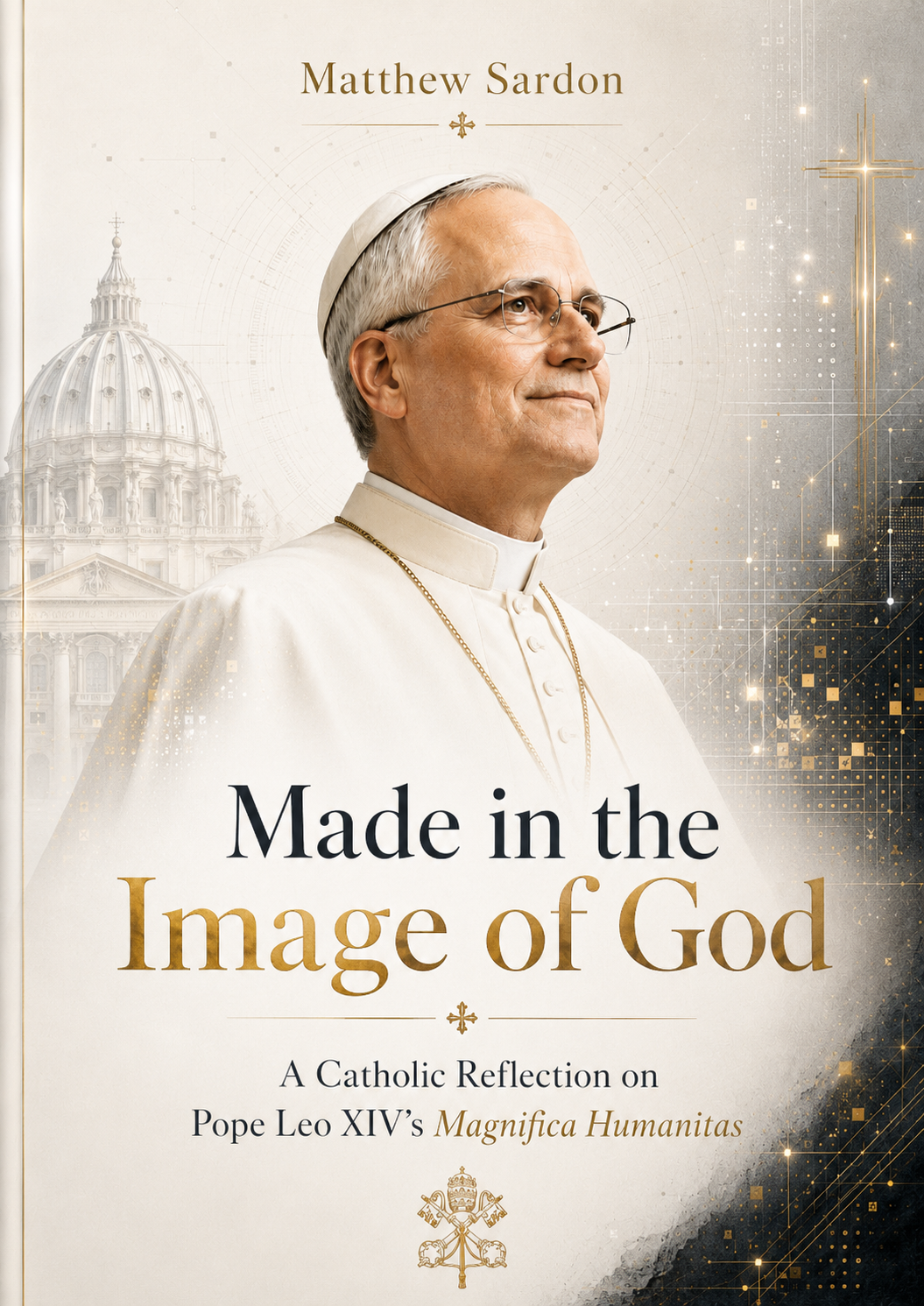
Made in the Image of God: A Catholic Reflection on Pope Leo XIV’s Magnifica Humanitas
Pope Leo XIV’s first encyclical, Magnifica Humanitas, speaks directly into one of the defining questions of our age: how can the human person be safeguarded in a world increasingly shaped by artificial intelligence?
Made in the Image of God is a Catholic reflection and theological analysis of that encyclical. Written for ordinary Catholics, it unfolds Pope Leo’s vision of human dignity, freedom, conscience, truth, work, technology, and the common good in light of Scripture, Catholic tradition, and the Church’s social teaching.
This is not a technical manual on AI. Nor is it a fearful rejection of modern technology. It is a guide to understanding what Pope Leo is asking the Church to see: that the rise of artificial intelligence is not merely a question of machines, but a question of man.
Through the encyclical’s central themes — Babel and Jerusalem, the image of God, the limits of artificial intelligence, the dignity of the worker, synthetic reality, moral responsibility, Eucharistic communion, and Mary’s Magnificat — Matthew Sardon shows how Magnifica Humanitas calls Catholics to recover the truth of the human person in Christ.
AI may calculate, generate, predict, and imitate. But it cannot love, repent, worship, forgive, receive grace, or bear the image of God.
Man can.
Made in the Image of God helps readers receive Magnifica Humanitas not as a distant papal document, but as an urgent call to remain human in Christ amid the technological age.